Detailed Guide to Screen Printing Process for Fire Extinguisher Labels
- Share
- publisher
- CooPrinter
- Issue Time
- Nov 6,2026
Summary
Fire extinguisher labels and usage instructions are critical components of fire safety, requiring clear graphics and text, abrasion resistance, and accurate color reproduction. With its high precision and versatility, screen printing has become the preferred process for producing such labels. Based on the practical experience of CooPrinter Printing Equipment, this article systematically introduces the entire screen printing process for fire extinguisher labels.
Introduction
Fire extinguisher labels and usage instructions are critical components of fire safety, requiring clear graphics and text, abrasion resistance, and accurate color reproduction. With its high precision and versatility, screen printing has become the preferred process for producing such labels. Based on the practical experience of Taoxing Printing Equipment, this article systematically introduces the entire screen printing process for fire extinguisher labels, covering process challenges, solutions, equipment selection, operation steps, precautions, and maintenance points, to help enterprises achieve efficient and reliable production.
I. Process Challenges
Screen printing for fire extinguisher labels faces multiple challenges. First, smooth substrate surfaces tend to cause uneven ink adhesion, resulting in feathered edges. Second, color accuracy requirements are stringent—for example, the red fire extinguisher icon must conform to safety standards—but substrate base color differences (such as yellow paper) may cause color deviation, turning "lake blue" into "dark blue." In addition, insufficient screen exposure or excessive washing can create rough edges, affecting graphic clarity. Finally, improper ink viscosity control (e.g., too high causing screen pulling) or squeegee wear may lead to ink bleed, resulting in blurry or soiled labels. If these issues are not addressed, they will reduce the readability and durability of the labels.
II. Solutions
To address the above challenges, systematic measures are required. For color control, use electronic scales to precisely weigh ink (error ≤ 0.1 g) and record formulations (e.g., 70 g blue ink + 30 g yellow ink) to ensure batch consistency. For colored substrates, print a white underbase first to cover the base color, or select uniform materials with whiteness ≥ 90%. Overprinting should follow the "light first, dark later" principle (e.g., yellow before black) to avoid dull colors. For screen optimization, control exposure time to prevent edge peeling during washing, and use a spectrophotometer to measure LAB values (Δe ≤ 1.5 is acceptable) for comparison against the proof. Ink viscosity should be moderate, adjusted through mesh count (higher mesh count reduces ink layer thickness) and squeegee pressure, with unified parameters to reduce feathering. Before production, prepare a "color sample" by testing 10 pieces, and confirm accuracy before mass production.
III. Screen Printing Equipment Used
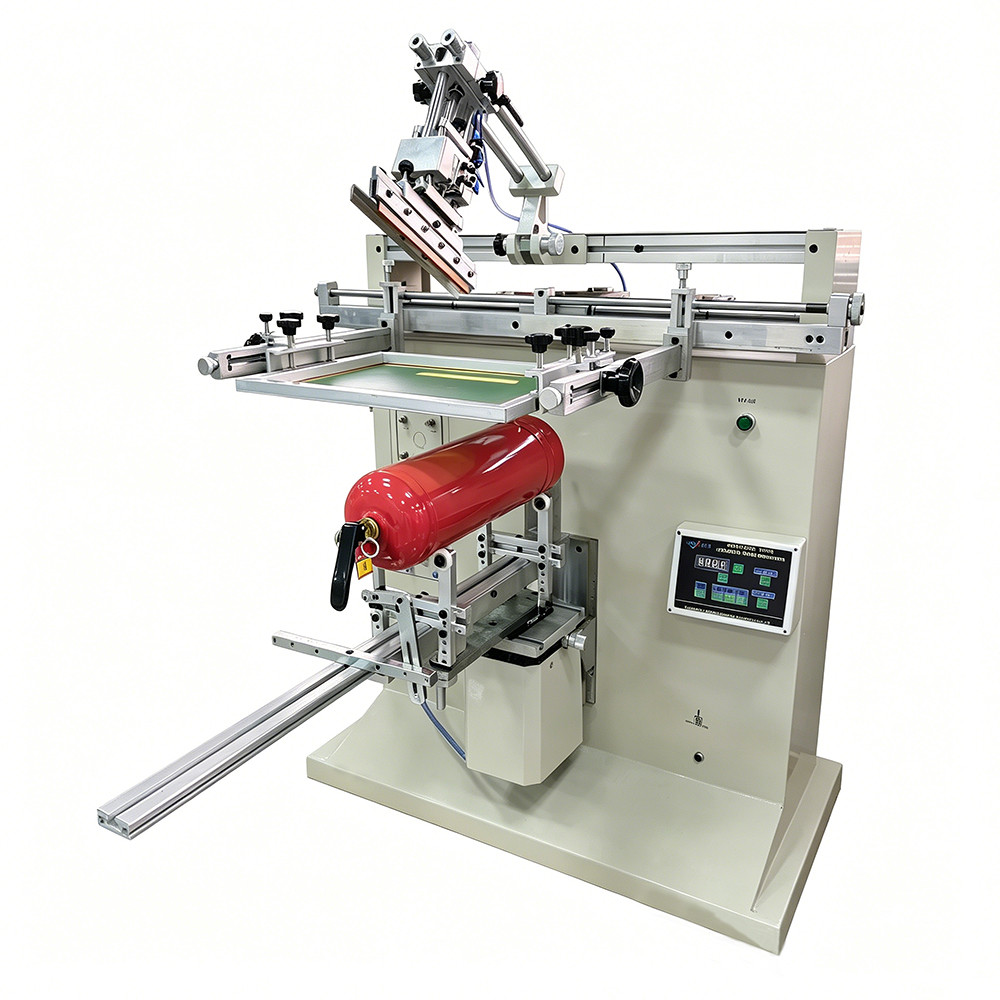
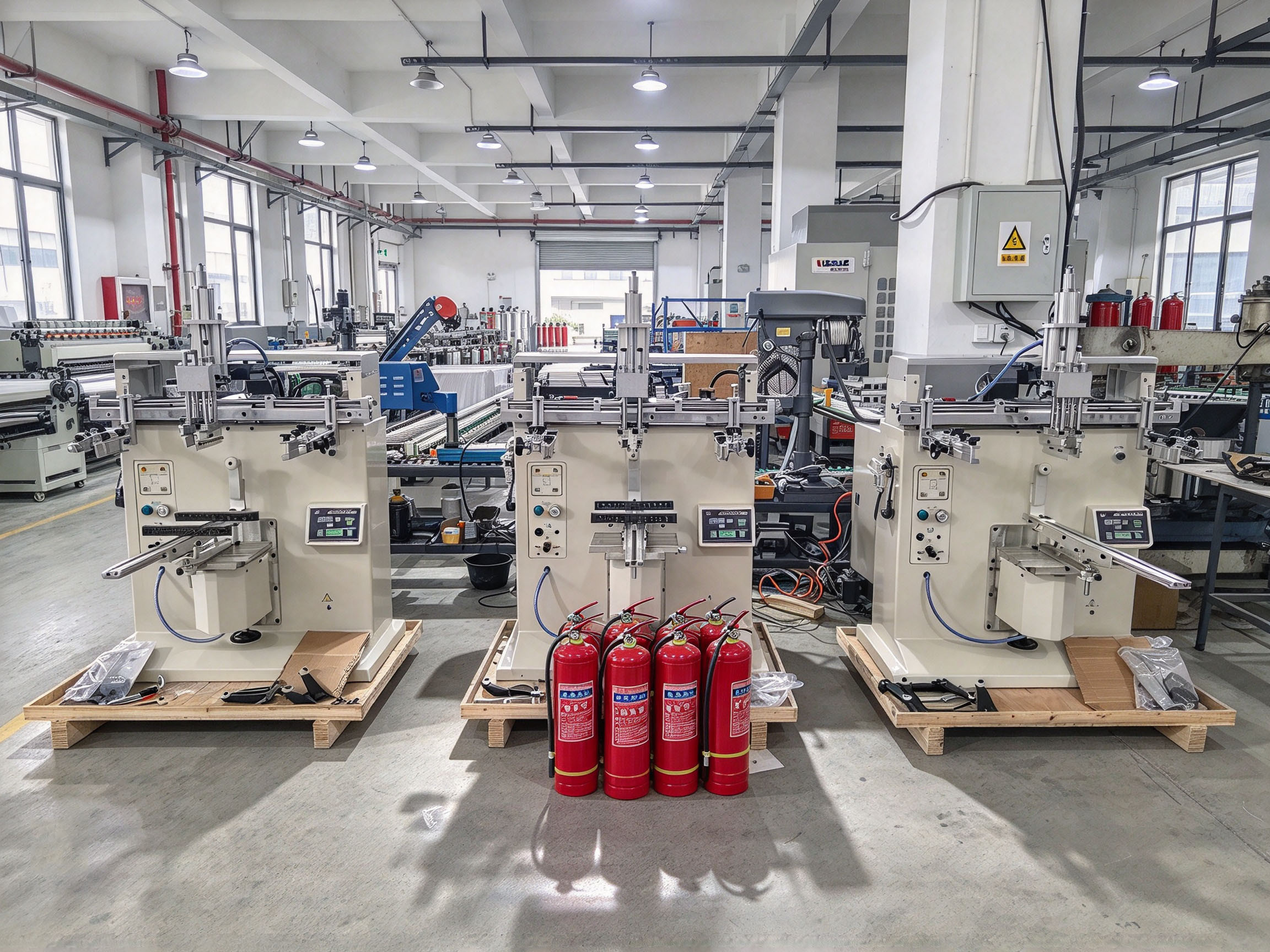
For fire extinguisher label screen printing, dedicated automated equipment is recommended, such as a fire extinguisher screen printing machine based on patented technology. The equipment consists of a main frame, loading table, and unloading table, equipped with a main lifting seat and plate fixing frame to achieve automatic bottle transfer. Core components such as a horizontal slide and bottle rotation mechanism can simultaneously complete loading and unloading during lifting actions, reducing manual intervention. The lifting squeegee design ensures uniform ink coating and is suitable for various rigid substrate materials. The equipment also integrates a tension control system to maintain screen stability and prevent printing misalignment. This automated solution improves efficiency by more than 30%, making it particularly suitable for batch production of fire extinguisher labels.
IV. Operation Procedure
Screen printing operations must be standardized, with the process divided into five steps:
1. Screen Preparation: Select an appropriate mesh count (e.g., 200–300 mesh), expose and cure the photopolymer emulsion, then wash (pressure < 0.3 MPa, time < 5 minutes), and inspect edge flatness.
2. Substrate Treatment: Clean the surface, remove oil and dirt, and ensure uniform base color.
3. Ink Preparation: Weigh ink according to the formulation, adjust viscosity to a moderate level, and avoid poor flowability.
4. Printing Execution: Fix the substrate on the equipment and start automatic squeegee printing. The squeegee must be sharp and free of nicks, with consistent pressure to ensure uniform ink layer thickness. For overprinting, print in sequence (e.g., icon first, then text).
5. Drying and Quality Inspection: After natural or hot-air drying, use a spectrophotometer to check color and reject products with feathered edges or color deviation. The entire process must be carried out in a dust-free environment.
V. Precautions
Safety regulations must be strictly followed during operation. For safety, wear protective equipment to avoid ink contact with skin; ensure good ventilation in the work area to prevent vapor accumulation. For precision control, regularly calibrate equipment parameters (e.g., squeegee angle), maintain screen tension at 20–25 N/cm², and prevent graphic deformation. When selecting materials, prioritize weather-resistant inks and uniform substrates (thickness 1 mm–2 mm) to ensure long-term outdoor clarity of labels. Before mass production, sample testing must be conducted and process cards (including screen data and ink ratios) recorded to avoid rework.
VI. Equipment Maintenance
Equipment lifespan depends on daily maintenance. Daily maintenance includes cleaning the squeegee and screen, removing ink residue with dedicated solvents, and checking lifting mechanism lubrication. Weekly maintenance involves calibrating horizontal slide accuracy and testing main lifting seat travel to ensure smooth bottle transfer. Quarterly maintenance includes replacing worn parts (e.g., squeegee blades) and verifying the tension system. For storage, screens must be kept away from light and moisture, and ink must be sealed. Taoxing equipment recommends using original manufacturer accessories to extend service life by more than 20%.
Conclusion
Screen printing is the core process for fire extinguisher label production. Through precise parameter control and automated equipment, process challenges can be overcome to produce high-quality labels. Enterprises should strengthen standardized operations and regularly maintain equipment to enhance the reliability of fire safety products.