Should I replace my screen printing machine after using it for a long time
- Share
- publisher
- CooPrinter
- Issue Time
- Sep 7,2026
Summary
Looking for reliable bottle printing equipment? Compare the world's top screen printing, pad printing and digital bottle printing machine manufacturers from Germany, Italy, Japan, Switzerland, the USA and China - including a full profile of CooPrinter.
That old machine in the factory might be secretly eating up your profits.
Most screen printing business owners probably have a machine like this: it's a treasure when you first buy it, but after five or six years, even the most skilled technicians find it a headache.
They might say, "It can still print, it'll do for now," but deep down they know perfectly well—today the scraper holder is leaking oil, tomorrow the mesh frame won't lock properly, and it just happens to break down when they're rushing to meet a deadline. If they try to fix it, the repairman says the parts are hard to find; if they don't fix it, the order form is still there.
Whether or not to replace it isn't really a matter of sentiment , but rather a matter of cost-benefit analysis. This article will clarify the costs and benefits: in which situations should you decisively replace it, in which situations can you hold out a little longer, and how to negotiate with the manufacturer to avoid being taken advantage of when replacing it.
Don't rush to change it, and don't force yourself to endure it.
I've seen two extreme types of bosses.
One approach is "don't replace the machine until it breaks down," where equipment is used until the screws are stripped, resulting in seven or eight days of downtime per month and a higher rework rate than competitors. In the end, the money lost is enough to buy half a new machine.
Another type is "getting excited when seeing a new model." The factory's machines have only been used for two years, and when they hear that a fully automatic machine has come out, they want to switch to it. However, the order volume cannot keep up, and the equipment sits idle, gathering dust.
There's only one criterion: Is this machine helping you make money or helping you spend it?
A well-maintained, accurate, and reliable old machine with few malfunctions can continue to be used without any problems. However, if it has reached the point of "repairing and breaking down every day," replacing it is not a waste, but rather a way to stop the damage. If you experience two or more of the following four signs, you should seriously reconsider your decision.
Four signals indicate it's time to replace it.
Signal 1: The number of repairs performed in a month exceeds the number of orders received.
This is the most obvious example. The machine breaks down every few days, and the first thing the technician does when he gets to work is to disassemble the machine instead of loading materials. It's normal for it to be repaired four or five times a month.
Let's do the math: Each half-day downtime, plus the technician's labor, parts costs, and delayed delivery, can amount to several thousand yuan in hidden losses per month. And in a year? That's enough for the down payment on a new machine.
What's even more critical is dealing with the clients. If you can't deliver urgent orders once or twice, they might understand, but if it happens repeatedly, the orders will go to competitors. This loss isn't visible on paper, but it hurts the most.
Signal 2: The defect rate is out of control, and adjusting the machine is driving me to the point of questioning my existence.
The printing process went awry; the ink layer became thicker on one side than the other. After spending the entire morning adjusting it, I had only printed two hundred sheets when it was already crooked again. The defect rate slowly climbed from around 2% when I first bought it to 5%, 8%, or even higher.
In this situation, we've tried replacing the doctor blade, the calibration platform, and the ink, but the results are inconsistent. Simply put, the core components are worn down to their limit, and the mechanical precision is irreversible.
Relying on rework to stay afloat? Rework requires labor, materials, and time; the profit margin is already thin, and it all goes into the pocket. Not to mention the scrap that can't be recovered after rework—pure loss.
Signal 3: The product turnover is too slow, and the company simply cannot handle both small and urgent orders.
Nowadays, customers need things urgently, in small batches, and with a wide variety of products. Changing the screen plate or adjusting the alignment on an old machine takes half a day, but when customers require same-day delivery, your machine is still being adjusted.
If a semi-automatic machine is only slightly slower than a fully automatic one, that's tolerable, since semi-automatic is more flexible. But if the machine's structure is outdated, and alignment relies entirely on the operator's feel, making each model change a gamble, then it really needs an upgrade.
During peak season, not being able to get orders is worse than not having any orders at all—if you can't fulfill a customer's request, they won't contact you again.
Signal 4: Parts are no longer in production, and there's nowhere to get them repaired.
This is the most passive situation. The machine has been used for over ten years, the manufacturer has long since stopped producing this model, key parts are unavailable, and the quality of aftermarket parts is inconsistent.
A hardware screen printing business owner once told me that one of the cylinders on his old machine broke down. It took him three months to find a spare part, and it cost him three times the usual price. For those three months, the machine was just a pile of scrap metal.
Therefore, when buying a machine, the contract should clearly state: how many years of spare parts supply after the warranty expires? Are there any alternatives for discontinued models? Don't wait until it breaks down beyond repair before you think about asking these questions.
Is it worth switching from a semi-automatic to a fully automatic machine?
Many factories start with semi-automatic screen printing machines, and then struggle with whether to switch to fully automatic machines once their order volume increases. There's no standard answer to this question; it depends on your order structure.
If your customers mainly have long-term, stable, large-volume orders, such as printing tens of thousands of pieces of a certain product every month, then fully automated systems have lower per-piece costs, save labor, and have better consistency. The payback period is usually short, making it worthwhile.
However, if you're producing small batches of many different products—printing two hundred cups today and three hundred boxes tomorrow—semi-automatic systems offer faster changeover times and greater flexibility, making them more cost-effective. Blindly going for fully automated systems without maximizing equipment utilization is simply a waste of money.
In short: Fully automated systems save on labor and batch costs, while semi-automated systems win in terms of flexibility and changeover speed. Which one you choose depends on your needs.
Don't replace all the machines at once if you have multiple machines.
If you have three to five machines in your factory, don't rush to replace them all. Not only will it put a lot of financial pressure on you, but you'll also need a break-in period to get used to the new machines.
It's recommended to replace them in batches: prioritize replacing the machine that has the most frequent malfunctions and the biggest impact on delivery. For example, if a flatbed screen printing machine runs at full capacity year-round, its stoppage will affect the entire line, so replace it first. If the curved screen printing machine is still working stably, it's okay to wait a bit.
Investing money in the "bottleneck" aspects is far more effective than spreading resources thinly. Once you've replaced one machine and it's running smoothly, then consider the next one.
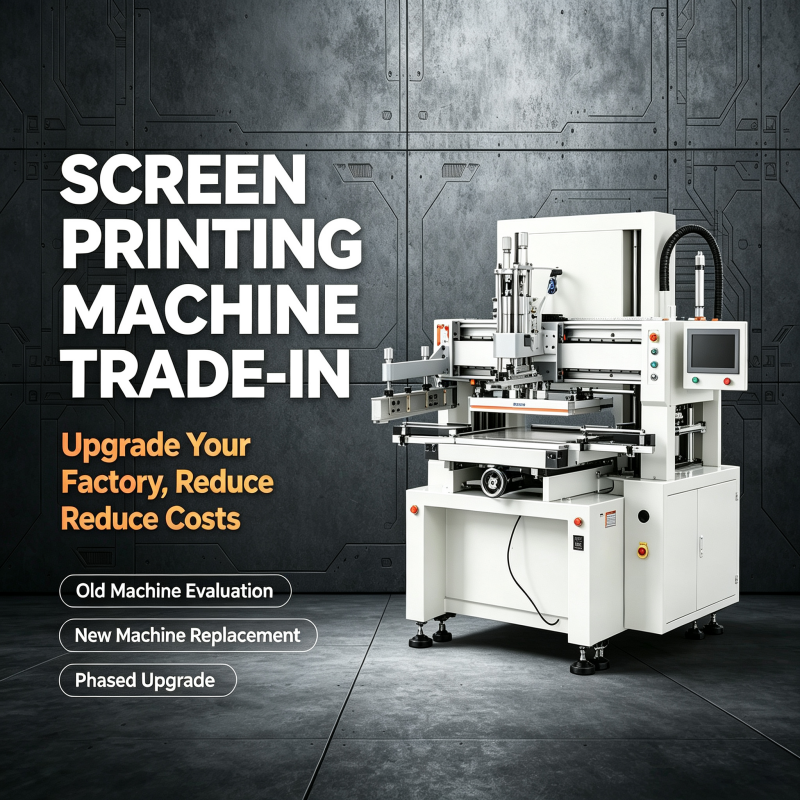
Trade-in program: Discuss these three things with the manufacturer
Many screen printing machine manufacturers now offer trade-in programs, which can save you money. However, when negotiating, don't just listen to what the salesperson says; there are three things you must ask about and include in the contract:
First, how is the used machine valued and how much can be traded in ? It's best to have the manufacturer come to your location to inspect and assess the machine, and provide a written quote. Avoid having them try to lower the price on-site.
Second, what is the delivery time for the new machine ? Especially during peak season, manufacturers have tight order schedules, so the delivery time should be written into the contract, and there should be a reason for any delays.
Third, who is responsible for and who pays for the removal of the old machine and the installation and debugging of the new machine ? A reliable manufacturer will handle everything from start to finish, so you don't have to find someone to dismantle and move the machine yourself.
If you can't reach an agreement on these three things, it's better to consult with two more companies. Replacing a device is a big deal, don't try to cut corners.
If you are considering upgrading your computer
Hangzhou Taoxing Printing Equipment Co., Ltd. has been manufacturing screen printing machines for many years, offering flatbed, curved, semi-automatic, and fully automatic models. We support trade-in assessments. Your old machine can be used to offset part of the cost of a new one. From on-site assessment and dismantling/recycling to new machine installation and operation training, we provide full support to ensure uninterrupted production during the trade-in period.
If you're planning to replace your device, you can have them come to your home to check the condition of your old device and get an estimate. This will give you a better idea of the price before deciding whether to replace it.
When it comes to machines, don't hesitate to replace them when they need to, and don't act impulsively when they don't. Making sure you understand the costs is more important than anything else.